When guaranteed contract hours exceed what the forecast needs, UKG Pro WFM correctly schedules the extra people onto real positions, and a one-person fryer slot shows three names. Here is how CloudApper moves that surplus into a Pool position inside UKG and gives Duty Managers a bench view to redeploy it.


Table of Contents
Surplus labor scheduling in UKG Pro WFM becomes a daily issue for any restaurant operator whose contracts guarantee employees a set number of hours, because those hours have to land somewhere even when the forecast needs fewer people. The schedule engine is doing its job when that happens: it honors the contract and the labor rules. CloudApper handles what comes next, making that surplus visible and usable for the manager running the shift without moving a single rule out of UKG.

A national quick-service restaurant operator in Poland, with about 600 restaurants and 32,000 employees, shows the pattern. Each restaurant runs 50 to 100 people, many on guaranteed monthly hours. As a forecasting and optimized scheduling consultant on the operator’s UKG implementation team put it, “A lot of the employees will effectively have a fixed number of hours that we are expected to schedule them for in a month… I have to schedule 10 people, but the labor forecast is telling me I only need six.”
When an Accurate Forecast Meets a Guaranteed-Hours Contract
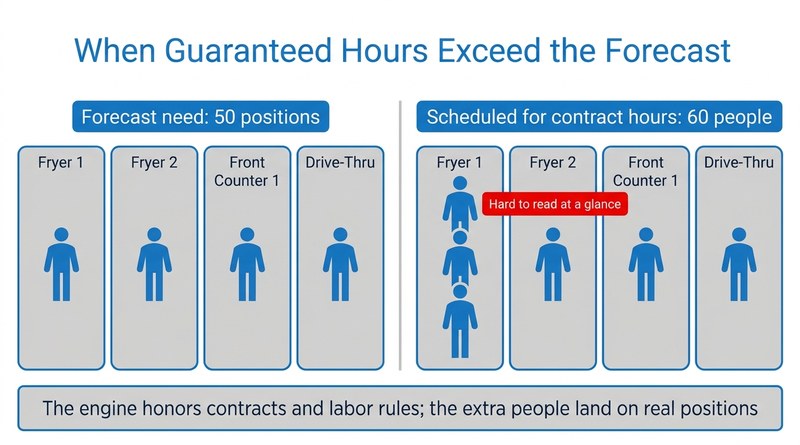
The operator models labor as single-person positions such as Fryer 1 through 4, Front Counter 1 through 6 and Drive-Thru. UKG Labor Standards and Forecasting turn expected guest counts into the exact positions each hour needs, and contract minimums, pay rules and Polish rules on daily hours, rest periods and junior workers all live in UKG’s rule engine. When 60 people must be scheduled against a need of 50, the extra ten go onto real positions, and a one-person fryer slot shows three names.
“What we don’t want is to schedule five people to run one fryer. It’s completely unnecessary, it doesn’t help.”
Scheduling consultant, quick-service restaurant operator
The surplus is paid, compliant time. The cost shows up on the screen. The Duty Manager, one step above crew and running 50 to 60 people, reads that schedule at shift start and every time someone calls in sick, and stacked names hide who is spare, who arrives at 13:00 and which position is short. Anyone who has handled last-minute absences in restaurants knows how much that slows the response.
“I schedule these people because they have to meet their contract requirements. I’m paying them. They might as well come to work and do something.”
Scheduling consultant, quick-service restaurant operator
Reclassify the Surplus Inside UKG
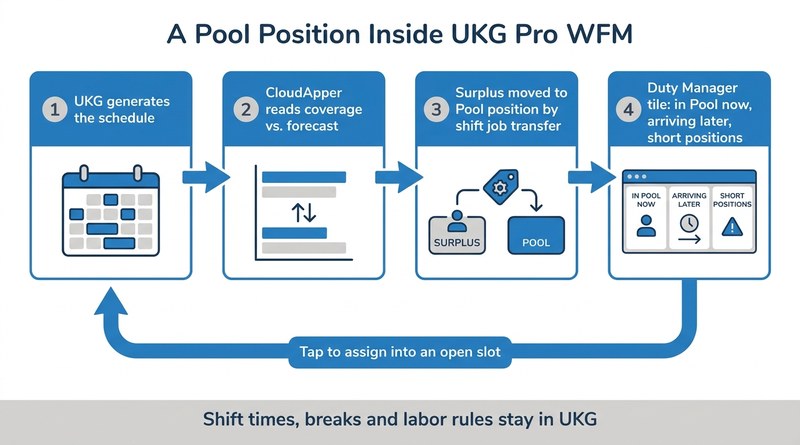
Moving scheduling into another tool is off the table, because pay rules, breaks and labor law have to stay where they are enforced. CloudApper’s approach, built with CloudApper AI for UKG Personalization and CloudApper iPaaS for UKG, works after UKG generates the schedule. It reads each restaurant’s schedule, coverage and forecast through the UKG Pro WFM scheduling APIs, calculates surplus per position and time span, and uses a configurable decision table to choose who moves. Those employees are transferred to a dedicated Pool position through a standard shift job transfer, so shift times, breaks and compliance stay exactly as UKG set them. Every move goes to a transaction ledger, and because the Pool is a real UKG position, payroll and compliance teams review it in the records they already use.
“We’re letting the schedule engine do the heavy lifting and we’re basically just undoing the bits of that are not appropriate.”
Scheduling consultant, quick-service restaurant operator
The Duty Manager gets a tile on the UKG Pro WFM home page, on desktop or mobile, scoped to their restaurant. It reads like a bench: who is in the Pool now, who arrives later and which positions are short. When someone calls in sick, the manager taps a Pool employee into the open slot and the change posts back to the UKG schedule, the kind of fast redeployment that filling last-minute call-outs in UKG Pro WFM depends on.
The Takeaway for Multi-Unit Operators on UKG Pro WFM
Guaranteed hours and an accurate forecast will disagree in some hours of every week. The decision that matters is where surplus labor sits once it is scheduled. A Pool position inside UKG keeps rules, pay and audit in one system, and because the decision table is configuration, the same logic can run across hundreds of restaurants. It is the same principle behind one shared view of people who are not yet fully scheduled, and CloudApper builds that layer so paid surplus hours become labor a manager can deploy.
If your restaurants schedule guaranteed hours the forecast does not need, talk to CloudApper about giving your managers a Pool view on top of UKG Pro WFM.



October 22, 2026
Construction Manpower Scheduling on UKG: The Weekly Negotiation Between Sixty Project Managers
At a project-driven contractor, next week's schedule is negotiated: project managers lend and borrow technicians so every crew gets 40 hours and every site has leadership. This piece looks at that weekly negotiation across sixty project managers, and how CloudApper adds project-based scheduling on top of UKG.

August 7, 2026
Building a Fair, SMS-Based Shift Fill Process on Top of UKG Pro WFM for Public Safety Agencies
An Australian government public safety authority needs SMS-based shift fill for fire and emergency services with four-layer eligibility filtering and overtime priority ordering. Here is why that is hard and how CloudApper AI Platform for UKG builds it on top of UKG Pro WFM.


December 6, 2024
Simplify Holiday Employee Scheduling Using CloudApper’s UKG/Kronos TimeClock
Streamline holiday scheduling with CloudApper AI. Simplify shift management, automate approvals, and reduce last-minute stress. Empower employees with schedule control, ensure attendance, and integrate seamlessly with UKG. Handle the holiday rush confidently while boosting efficiency and employee satisfaction.

May 2, 2024
How UKG Users Can Ensure Optimal Shift Coverage With CloudApper AI
Unfilled shifts disrupt operations and cost businesses. UKG users can ensure optimal coverage with CloudApper AI's Shift Optimization solution for shift trading, bidding, and confirmations.