UKG Okta user provisioning automates employee lifecycle management, enhancing security and efficiency by instantly updating access rights, reducing risks, and streamlining HR processes.



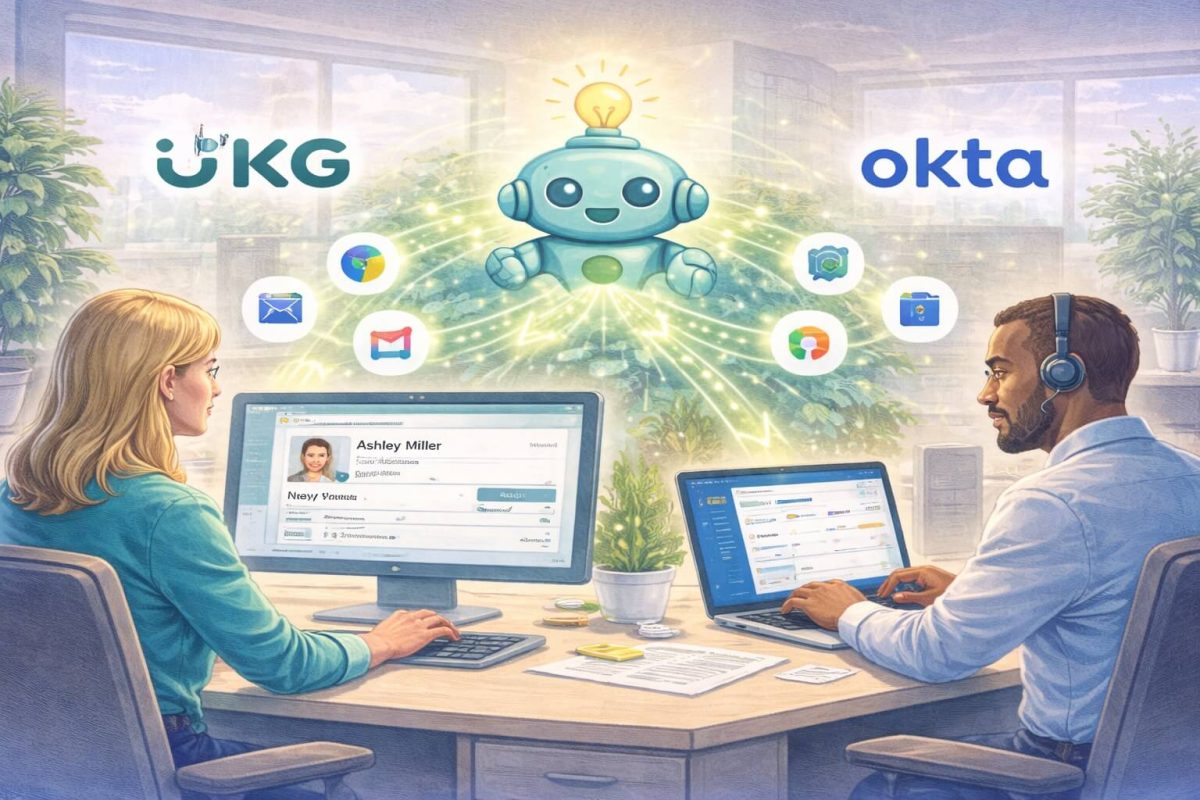
Table of Contents
What if you could stop worrying about whether ex-employees still have access to your company systems?
Here’s a scenario that keeps IT and HR teams up at night: someone gets terminated on Friday afternoon. HR updates their status in UKG, but now someone needs to remember to disable their Okta account, revoke their access to Slack, remove them from shared drives, and make sure they can’t log into anything over the weekend. Miss one step, and you’ve got a security risk sitting there until someone notices on Monday—or worse, weeks later during an audit.
This juggling act happens every single time someone leaves your company or changes roles. It’s manual, it’s stressful, and it’s easy to mess up. One forgotten account could mean unauthorized access to sensitive data, compliance violations, or security breaches that could have been prevented with a simple checkbox.
That’s exactly what UKG Okta user provisioning solves. When you connect UKG and Okta, employee changes happen automatically across both systems. Terminate someone in UKG? Their Okta access gets revoked immediately—no separate ticket, no follow-up email, no hoping someone remembered to do it. Hire someone new? They get the right access on day one without IT scrambling to set up accounts. Promote someone? Their permissions update automatically to match their new role.
UKG Okta user provisioning isn’t just about convenience—it’s about closing security gaps that manual processes create. It means your IT team stops playing catch-up with access requests, and your HR team doesn’t have to track down whether every system got updated. Everything just works, automatically, the moment something changes in UKG.
What is UKG Okta User Provisioning and Why Does It Matter?
UKG Okta user provisioning refers to the automated process of managing user identities and access rights between UKG, a leading HR and payroll system, and Okta, a robust identity management platform. This integration ensures that changes in employee status—such as onboarding, role adjustments, or terminations—are reflected instantly across both systems. Why does this matter? In an era where data breaches can cost millions and compliance regulations like GDPR demand precision, manual processes simply can’t keep up. By automating these workflows, businesses minimize human error and ensure that access permissions align perfectly with an employee’s current role, reducing the risk of unauthorized access to sensitive information.
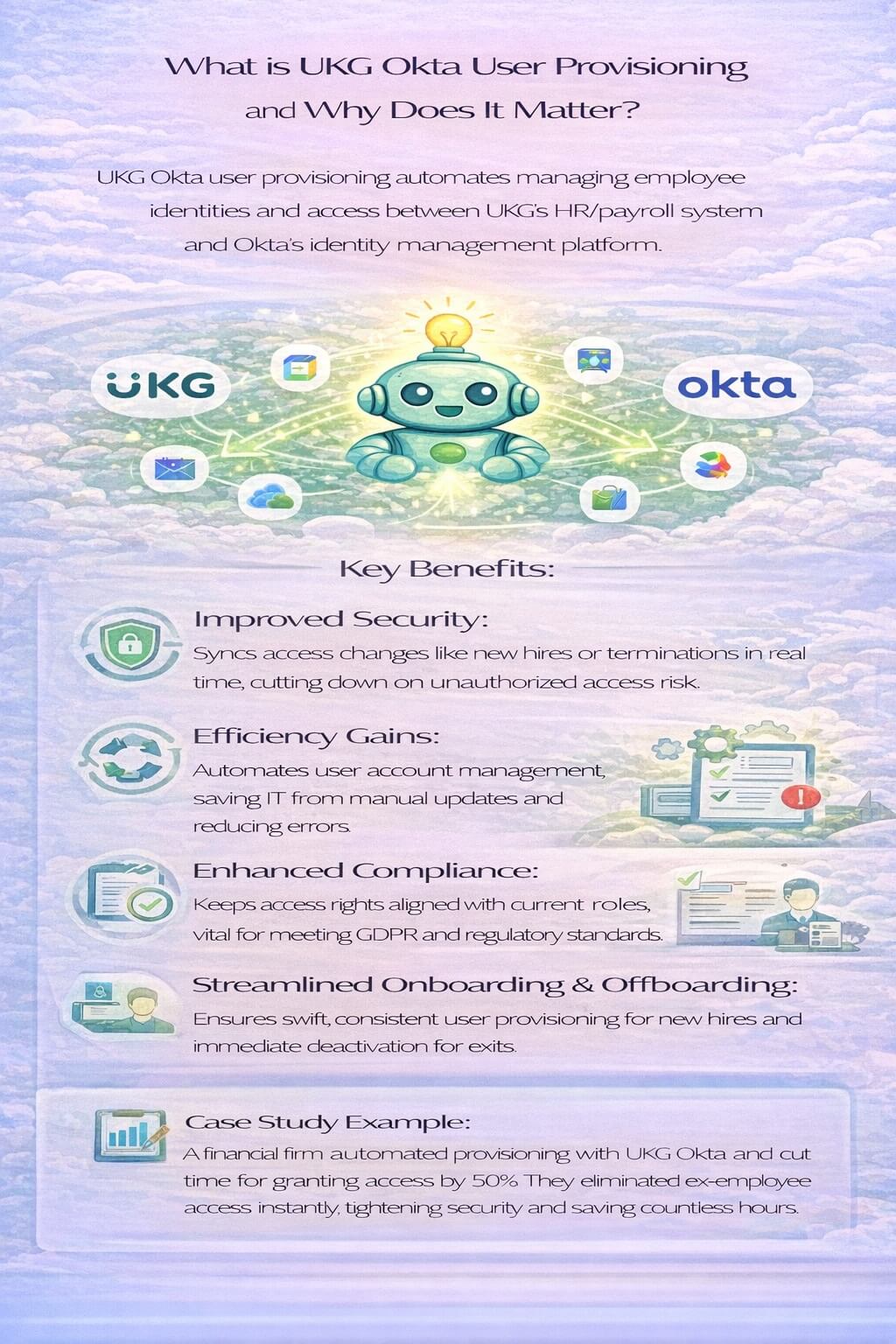
From my perspective as an expert in HR technology, I’ve observed that many organizations underestimate the hidden costs of disjointed systems. For instance, a simple role change might require IT to manually update permissions, leading to delays that could expose proprietary data. UKG Okta user provisioning addresses this by creating a bidirectional sync, where updates in one system trigger immediate actions in the other. This isn’t just about convenience; it’s about building a resilient infrastructure that supports growth without compromising security.
How Does UKG and Okta Integration Streamline HR Automation?
Integrating UKG and Okta goes beyond basic connectivity—it’s about creating intelligent workflows that adapt to your organization’s needs. Tools like CloudApper iPaaS for UKG make this possible with pre-built connectors that link the two platforms seamlessly. Imagine onboarding a new hire: Their details entered in UKG automatically provision a user account in Okta, granting access to necessary applications without IT intervention. This level of HR automation reduces onboarding time from days to hours, allowing new employees to hit the ground running.
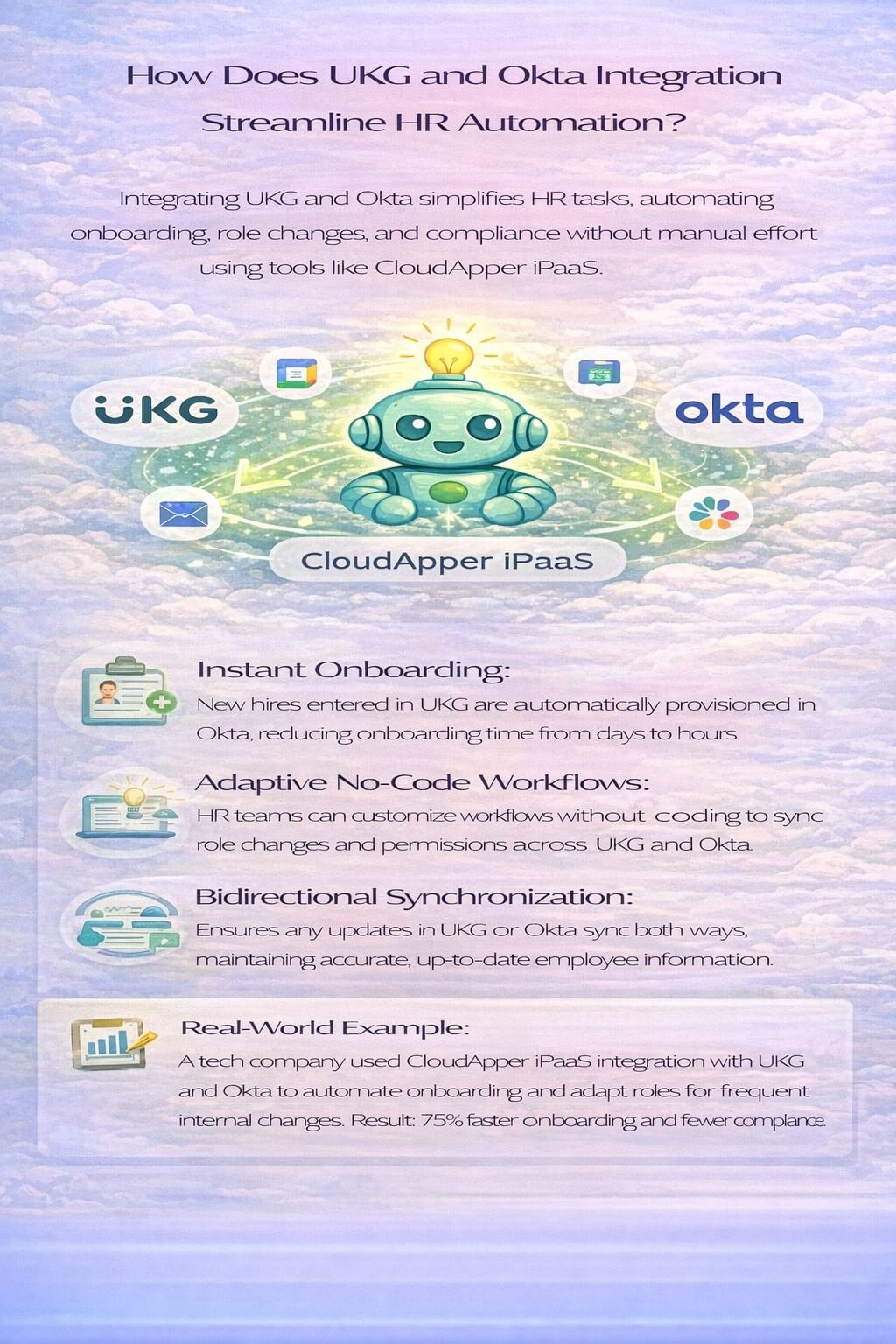
One key aspect is the no-code customization offered by CloudApper iPaaS. HR managers can design workflows tailored to specific scenarios, such as automatically updating Okta groups when an employee’s role changes in UKG. This flexibility is invaluable for industries with high employee mobility, like retail or tech, where roles evolve rapidly. Moreover, the AI-driven workflows in CloudApper iPaaS analyze patterns and automate complex decisions, ensuring consistency and accuracy. In practice, this means fewer compliance audits flagged for discrepancies, as all changes are logged and synchronized in real time.
Consider the broader impact on operational efficiency. Traditional methods often involve spreadsheets, emails, and manual verifications, which are prone to oversights. With UKG and Okta integration via CloudApper iPaaS, these pain points vanish. Bidirectional sync ensures data flows both ways—if a user’s access is modified in Okta, it updates UKG accordingly, maintaining a single source of truth. This not only saves time but also empowers HR teams to focus on talent development rather than administrative drudgery.
What Are the Security Benefits of Automating Employee Lifecycle Management?
Security is the cornerstone of effective employee lifecycle management, and UKG Okta user provisioning excels here by enforcing zero-delay access controls. When an employee is terminated in UKG, CloudApper iPaaS instantly revokes their Okta access, preventing potential insider threats or data leaks. This immediate response is crucial in scenarios where former employees might retain access to email, cloud storage, or internal networks, posing significant risks.
Drawing from industry trends, cyberattacks targeting HR systems have surged, often exploiting gaps during employee transitions. CloudApper iPaaS mitigates this with its security-focused features, such as automated permission updates for role changes. For example, if a manager is promoted, the system uses its iPaaS engine to adjust Okta groups, granting elevated access while revoking unnecessary privileges. This granular control supports compliance with standards like HIPAA, ensuring that only authorized personnel handle sensitive data.
In my experience, organizations that adopt such integrations report a marked decrease in security incidents. A hypothetical case: A financial services firm previously faced a breach due to delayed access revocation. After implementing CloudApper iPaaS for UKG Okta user provisioning, they automated the process, resulting in zero incidents over subsequent quarters. The managed services provided by CloudApper further enhance this by offering expert oversight, ensuring deployments are secure and optimized from day one.
How Can CloudApper iPaaS Solve Common Pain Points in HR Processes?
Many businesses grapple with pain points like manual data entry, which not only consumes hours but also introduces errors that can lead to compliance violations. CloudApper iPaaS for UKG addresses this head-on by automating data synchronization between UKG and Okta. No more redundant updates—changes in employee status propagate automatically, ensuring accuracy and freeing up resources.
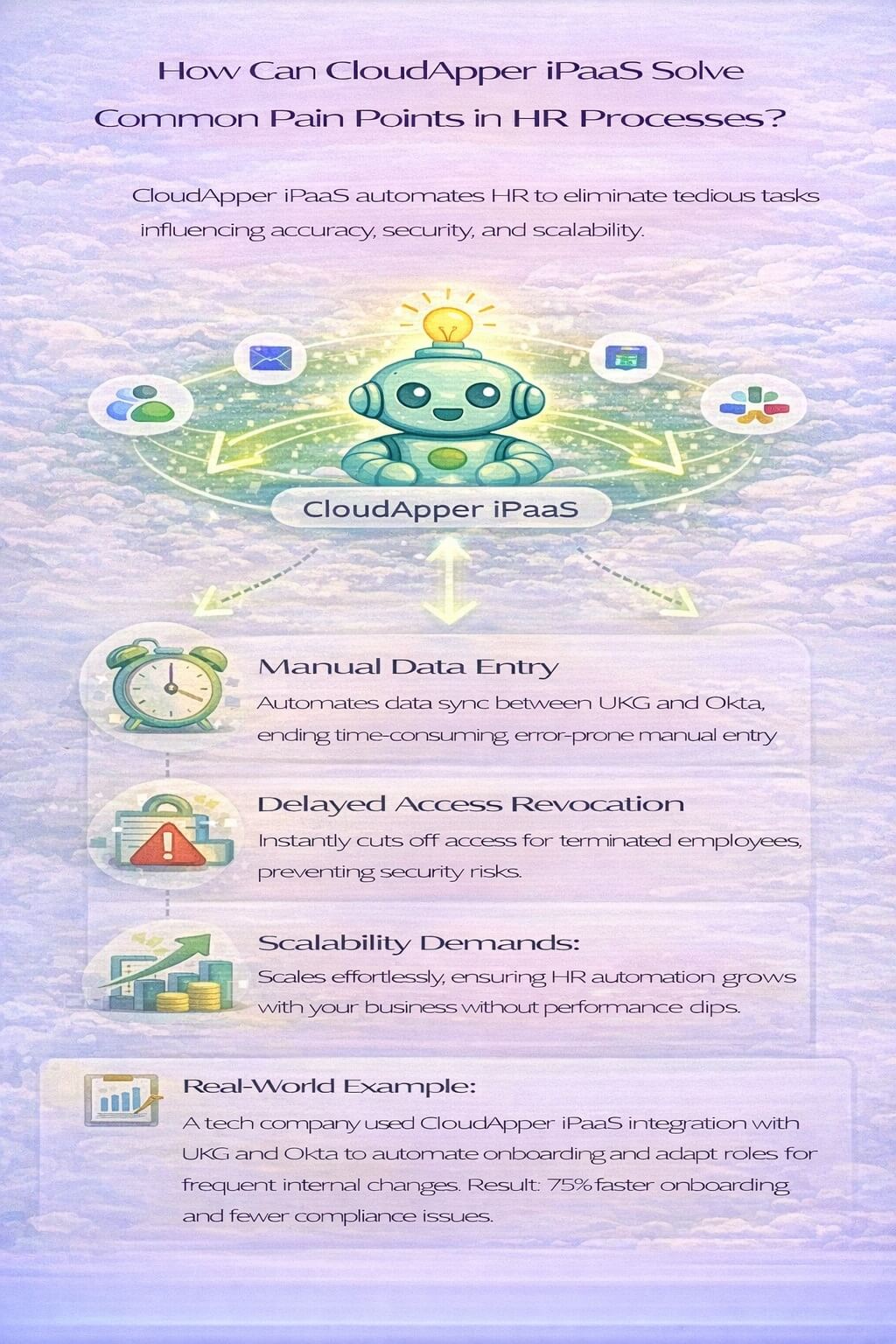
Another frequent issue is delayed access revocation during terminations. With traditional setups, it might take days for IT to process requests, leaving windows for unauthorized access. CloudApper’s solution closes this gap instantly, using its AI-driven engine to trigger actions based on UKG events. For role change management, custom workflows ensure permissions are updated without manual input, adapting to shifts like departmental transfers or promotions.
Scalability is another area where this integration shines. As organizations grow, so do their integration needs. CloudApper iPaaS scales effortlessly, handling increased data volumes without performance dips. This makes it ideal for medium to large enterprises looking to future-proof their HR automation strategies.
Real-World Examples of UKG Okta User Provisioning in Action
To illustrate the transformative power of this integration, let’s explore some real-world examples. In the retail sector, a company managing seasonal hires used CloudApper iPaaS to automate onboarding. New employees’ UKG profiles triggered Okta account creation, complete with role-based access to inventory systems. This reduced setup time by 70%, allowing the team to focus on customer service during peak seasons.
In a tech firm with frequent internal promotions, role changes often caused access mismatches. Implementing UKG and Okta integration via CloudApper automated these updates, ensuring developers gained access to new tools immediately upon promotion. This not only boosted productivity but also enhanced employee satisfaction by eliminating frustrating delays.
Even in healthcare, where compliance is paramount, organizations have benefited. A hospital network integrated UKG with Okta to manage staff terminations securely. Instant revocations prevented access to patient records, aligning with HIPAA requirements and averting potential fines. These examples underscore how CloudApper iPaaS turns theoretical benefits into tangible outcomes, driving efficiency and security across diverse industries.
Why Choose CloudApper iPaaS for Your UKG and Okta Integration Needs?
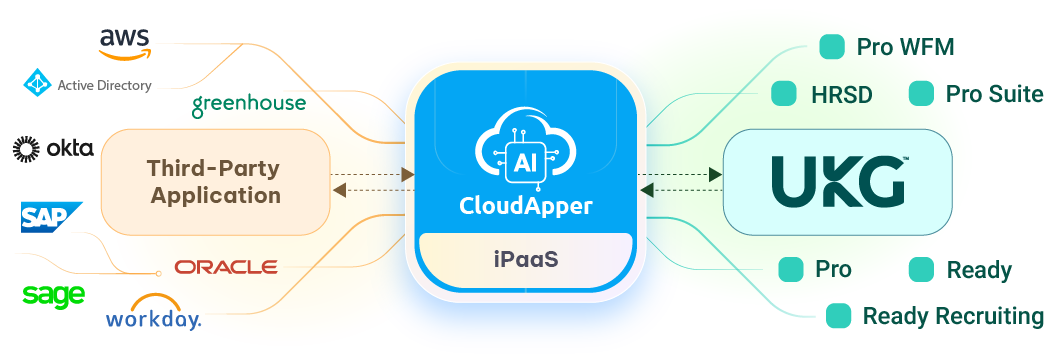
CloudApper iPaaS stands out as a no-code, fully managed platform that connects UKG to Okta and beyond, offering features like pre-built connectors and bidirectional sync. Its AI-driven workflows intelligently handle complex scenarios, while managed services ensure quick deployment and ongoing support. The key benefits—enhanced security, operational efficiency, compliance accuracy, and scalability—make it a strategic choice for forward-thinking leaders.
What sets it apart is the focus on flexibility. Whether you’re dealing with custom workflow development for role changes or ensuring data integrity, CloudApper empowers non-technical users to build solutions that fit perfectly. In an opinion rooted in years of industry observation, investing in such automation isn’t optional—it’s essential for staying competitive in a digital-first world.
FAQ: Common Questions About Automating Employee Lifecycle Management
What makes CloudApper iPaaS ideal for HR automation?
It provides no-code tools and AI workflows to automate tasks like UKG Okta user provisioning, reducing manual effort and enhancing accuracy.
How does this integration improve compliance?
Real-time sync ensures audit-ready records, supporting regulations by maintaining precise access controls.
Can small teams implement UKG and Okta integration easily?
Yes, with pre-built connectors and managed services, even non-IT staff can set up and customize workflows quickly.
What if my organization has unique workflow needs?
CloudApper’s no-code customization allows tailoring integrations to specific requirements without coding expertise.
In wrapping up, automating employee lifecycle management with UKG Okta user provisioning through CloudApper iPaaS isn’t just an upgrade—it’s a necessity for secure, efficient, and scalable HR operations. By eliminating manual processes and fortifying security, it positions your organization for long-term success. Ready to revolutionize your workflows? Visit CloudApper today to explore how iPaaS for UKG can integrate seamlessly with Okta and transform your HR landscape—take the first step toward automation excellence now.
- How does the UKG and Okta integration improve security?
- The integration uses CloudApper iPaaS to automate access revocations and permission updates, minimizing the risk of unauthorized access and maintaining compliance with regulations.
- Are there any prerequisites for implementing CloudApper iPaaS?
- No prerequisites are required; the integration is designed to be user-friendly and easy to deploy without needing extensive technical knowledge.
- Is CloudApper iPaaS suitable for small businesses?
- While particularly beneficial for medium to large organizations, small businesses with complex HR processes may also find value in its no-code automation and time-saving capabilities.
- What kind of support is available for implementing CloudApper iPaaS?
- CloudApper provides managed services, ensuring expert support for quick deployment and ongoing maintenance.
- What are the operational benefits of integrating UKG and Okta?
- The integration enhances operational efficiency by reducing manual tasks, ensures accurate data through real-time synchronization, and supports scalability for growing teams.