UKG Pro and UKG Ready give recruiting teams a solid ATS foundation — but when application volumes spike, manual screening, slow follow-ups, and scheduling delays push candidates out of the funnel. AI recruiting tools extend the UKG applicant tracking system with automated screening, conversational applications, and continuous candidate engagement. This guide covers how it works, where it helps most, and what to look for.


Table of Contents
- Why High-Volume Hiring Breaks Standard UKG Recruiting Workflows
- What UKG Talent Acquisition Looks Like With AI in the Workflow
- The Kronos Recruiting Legacy and What UKG Users Need to Know
- Where AI for UKG Talent Acquisition Delivers the Most Value
- Bias Reduction in UKG Talent Acquisition: What AI Can and Cannot Do
- CloudApper AI Recruiter for UKG Pro and UKG Ready: How It Works
- Frequently Asked Questions
- Conclusion
- Key Takeaways
UKG Pro and UKG Ready are two of the most widely used workforce management platforms in North America, serving organisations across retail, healthcare, manufacturing, logistics, hospitality, and a broad range of other industries where frontline and hourly hiring happens at scale. Formerly known as Kronos and Ultimate Software before the merger that created UKG, these platforms have a deep and well-established user base — many of whom still search under the legacy Kronos brand name — and they provide a solid foundation for managing the full employee lifecycle from recruitment through payroll and scheduling.
UKG’s applicant tracking system capabilities, embedded within UKG Pro Recruiting and UKG Ready, give HR and talent acquisition teams the tools to manage job postings, candidate workflows, offer letters, and onboarding. For organisations hiring for office-based or professional roles at moderate volumes, these native capabilities often meet the need. The challenge emerges at the edges of what a standard ATS is designed to handle — specifically in high-volume, frontline, and seasonal hiring environments where application volume spikes, candidate drop-off is high, and the manual effort required to move candidates from application to interview far exceeds the capacity of the recruiting team.
This is where AI for UKG recruiting creates measurable operational value. Not by replacing UKG as the system of record, but by automating the friction-heavy steps that slow down the process — resume screening, candidate scoring, pre-screening, scheduling, and communication — so that recruiters spend their time on the work that requires human judgment rather than administrative overhead. This guide explains what UKG talent acquisition looks like when AI is layered into the workflow, what to look for in an AI recruiting solution for UKG, and how organisations in high-volume hiring environments are using tools like CloudApper AI Recruiter for UKG to hire faster and more consistently.
Why High-Volume Hiring Breaks Standard UKG Recruiting Workflows
The UKG applicant tracking system is built to manage structured hiring workflows — requisition approvals, job postings, candidate pipelines, interview coordination, and offer management. For most professional and administrative hiring, this works well. The process is predictable, volumes are manageable, and recruiter capacity is sufficient to handle each stage with appropriate attention.
High-volume hiring is a fundamentally different problem. When a retailer needs to staff fifty seasonal positions before the holiday period, when a healthcare network is filling dozens of clinical support roles simultaneously, or when a logistics company is onboarding warehouse operatives for a new distribution centre, the assumptions that underpin standard ATS workflows break down quickly. The issue is not the software — it is the ratio of manual steps to available recruiter time.
Even a brief review of each application becomes untenable when hundreds arrive in a short window. Scheduling thirty interviews requires dozens of email exchanges unless the process is automated. Following up with candidates who have gone quiet after applying requires time that recruiters do not have when they are simultaneously managing multiple open roles. And candidates, for their part, do not wait. SHRM has reported that median time-to-fill runs at roughly six weeks under normal conditions — in high-volume environments, that timeline compresses further because candidates accept other offers rather than wait for a response that has not yet arrived.
Quick answer: Does UKG have an applicant tracking system?
Yes. UKG Pro and UKG Ready both include applicant tracking system (ATS) functionality for managing job requisitions, candidate workflows, interviews, offers, and onboarding. For organisations that need deeper automation around high-volume screening, candidate engagement, and conversational application flows, AI recruiting tools like CloudApper AI Recruiter integrate directly with UKG’s ATS to extend these capabilities without replacing UKG as the system of record.
The 92% application abandonment rate documented by SHRM research is the starkest illustration of this problem. Nine out of ten candidates who express interest by clicking apply never complete the process. The primary causes are application length, process complexity, and slow or absent follow-up — all of which are solvable through automation rather than additional recruiter headcount.
AI for UKG Pro and UKG Ready recruiting addresses these failure points directly. By automating the steps where candidates get stuck and where recruiters run out of capacity, it makes the UKG applicant tracking system significantly more effective at the volumes and speeds that frontline and seasonal hiring demands.
What UKG Talent Acquisition Looks Like With AI in the Workflow
Understanding how AI integrates with UKG talent acquisition helps HR leaders, IT teams, and operations directors evaluate what is genuinely possible versus what is marketing language. The key distinction is between AI tools that replace the ATS and AI tools that extend it. The former requires a platform migration — a significant undertaking with substantial cost, risk, and disruption. The latter works within the UKG environment already in place, adding capabilities at the workflow layer without touching the system of record.
CloudApper AI Recruiter is designed specifically for the latter model. UKG Pro or UKG Ready remains the authoritative platform for all candidate and hiring data. CloudApper AI Recruiter connects through standard integration and adds automation, conversational workflows, and screening intelligence at the points where the UKG ATS alone creates bottlenecks. The result is a UKG talent acquisition workflow that retains the governance, reporting, and data integrity of the core platform while operating significantly faster and with far less manual effort at every stage.
Stage One: Reducing Application Friction
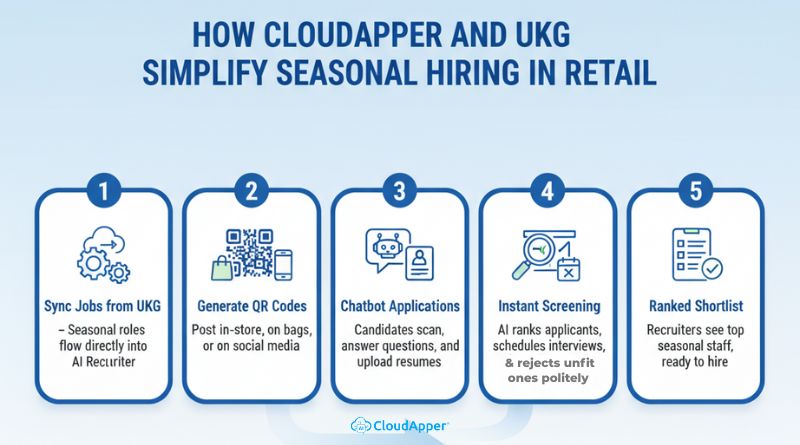
The first and most significant point of candidate drop-off is the application itself. Long-form applications that require account creation, multi-page form completion, and document uploads were designed for a desktop-based, considered application experience. For hourly and frontline candidates who are often applying from a mobile device between shifts, this experience is a barrier rather than a gateway.
CloudApper AI Recruiter removes that barrier by enabling candidates to begin the application process through a QR code scan, an SMS shortcode, or a chat interface. Instead of encountering a full application portal immediately, candidates enter a guided conversational flow that collects the information recruiters actually need — availability, relevant experience, location, role-specific criteria — in a format that takes minutes rather than the better part of an hour. This approach directly addresses the application abandonment problem and widens the top of the talent funnel without requiring any changes to UKG’s underlying configuration.
Stage Two: Consistent Screening at Scale
Once applications arrive, the UKG applicant tracking system provides the workflow structure to manage them. The gap that AI fills is at the evaluation layer — specifically, how candidates are assessed and ranked when volume is high. Manual review under volume pressure introduces variability: different reviewers prioritise different signals, strong candidates with unconventional formatting get passed over, and the candidates reviewed first tend to receive more thorough attention than those reviewed at the end of a long session.
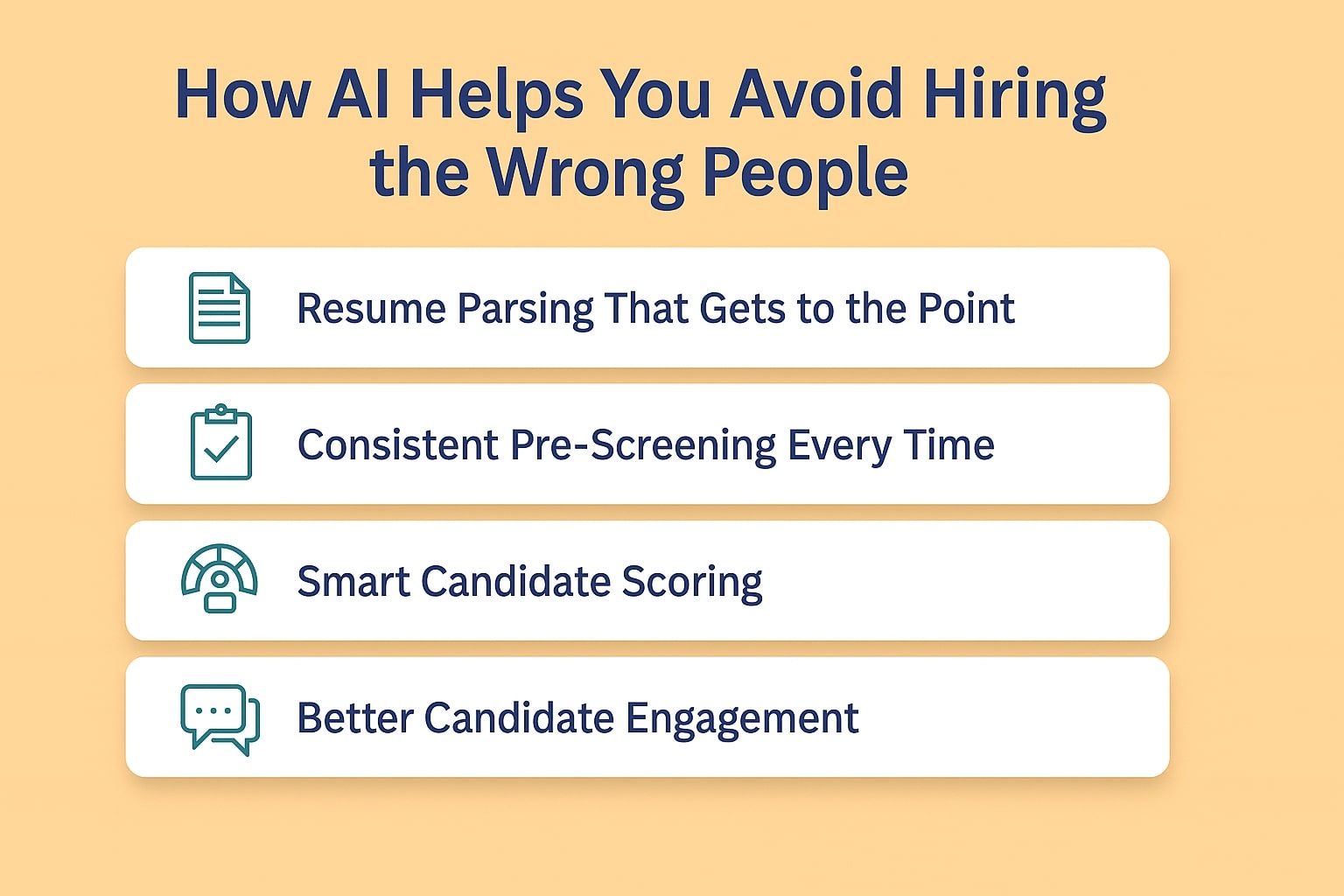
CloudApper AI Recruiter evaluates every candidate against the same job-aligned criteria, regardless of when their application arrived or who is doing the reviewing. The output is a scored, ranked shortlist that reflects genuine fit rather than review order or recruiter fatigue. This consistency is the core operational value of AI screening — not speed alone, but the quality and fairness of the shortlist that reaches the hiring team.
Stage Three: Dynamic Pre-Screening
Standard pre-screening forms collect static responses that often do not provide enough information to make a meaningful screening decision. For roles where shift availability, physical requirements, certifications, or location constraints are the real qualifying factors, a generic set of questions adds friction without adding insight.
AI-powered pre-screening for UKG recruiting allows for dynamic, branching question flows that adapt based on candidate responses. If a candidate indicates they are available for overnight shifts, the system can probe further into their specific availability pattern. If a role requires a specific certification, the system can verify and record that detail conversationally. The result is richer candidate data that supports faster and more confident screening decisions, all captured through an experience that feels like a conversation rather than a form.
Stage Four: Automated Interview Scheduling
Interview scheduling is one of the most time-consuming administrative tasks in recruiting, and one of the most straightforward to automate. The back-and-forth involved in finding a mutually suitable time between a candidate, a recruiter, and a hiring manager — often across multiple rounds — is a pure coordination exercise that does not require human judgment. It simply requires speed and reliability.
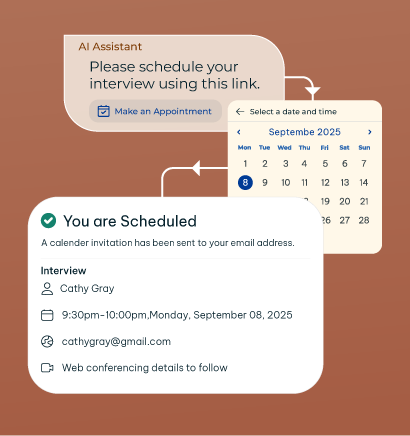
CloudApper AI Recruiter automates this entirely. Once a candidate advances to the interview stage, the system presents available time slots, collects the candidate’s selection, sends calendar confirmations to all parties, dispatches reminders ahead of the interview, and handles rescheduling requests without recruiter involvement. For Kronos and UKG users managing large numbers of open roles simultaneously, this automation alone can reclaim substantial recruiter capacity each week.
Stage Five: Continuous Candidate Engagement
The period between application and interview is where candidate drop-off is highest. Candidates who hear nothing after applying assume they have been unsuccessful and move on. Candidates who receive an automated acknowledgement but then experience days of silence reach the same conclusion. In a competitive labour market, particularly for frontline and hourly roles where candidates are often considering multiple opportunities simultaneously, communication speed is a direct competitive advantage.
CloudApper AI Recruiter maintains continuous engagement through SMS, email, and chat from the moment an application is submitted. Status updates, pre-screening prompts, interview invitations, reminders, and follow-up messages are all automated and triggered by workflow events rather than recruiter action. Candidates receive a responsive, attentive experience regardless of how many open roles the recruiting team is managing — and the organisation’s employer brand benefits accordingly.
The Kronos Recruiting Legacy and What UKG Users Need to Know
A significant portion of UKG’s current user base originally implemented the platform as Kronos Workforce Ready or Ultimate Software’s UltiPro before the 2020 merger that created UKG. Many HR and IT professionals who work with these systems daily still use the Kronos name when searching for help, integrations, and solutions — which is reflected in the search behaviour around terms like Kronos applicant tracking system, Kronos recruitment, and Kronos hiring.
For organisations in this position, it is worth being clear: UKG Pro is the successor to UltiPro, and UKG Ready is the successor to Kronos Workforce Ready. Both platforms continue to be actively developed and supported under the UKG brand. The applicant tracking and talent acquisition capabilities that existed in Kronos and UltiPro have been maintained and expanded within their UKG successors.
AI recruiting tools like CloudApper AI Recruiter that integrate with UKG Pro and UKG Ready are therefore equally relevant to organisations that think of themselves as Kronos users. The integration connects to the current UKG platform regardless of which legacy system was originally implemented, and the workflow improvements are the same whether the organisation is a long-standing Kronos customer or a more recent UKG adopter.
Where AI for UKG Talent Acquisition Delivers the Most Value
Not every organisation experiences the same recruiting challenges, and the value of AI integration with UKG’s applicant tracking system is strongest in specific contexts. Understanding where the impact is greatest helps recruiting and operations leaders prioritise their investment.
High-Volume Frontline and Hourly Hiring
This is where AI for UKG recruiting shows its value fastest and most clearly. Organisations hiring large numbers of hourly, frontline, or shift-based employees — in retail, warehousing, food service, healthcare support, manufacturing, or call centres — experience the highest application volumes, the most severe capacity constraints, and the greatest risk of candidate drop-off. Automating screening, engagement, and scheduling in these environments does not just improve efficiency — it fundamentally changes what the recruiting team is capable of without increasing headcount.
Seasonal Hiring Surges
Predictable hiring surges — holiday retail staffing, summer hospitality recruitment, healthcare capacity expansion during flu season — create temporary spikes in volume that overwhelm standard UKG ATS workflows. AI recruiting tools absorb these spikes by scaling automatically. The same configuration that handles fifty applications a week handles five hundred without additional setup, additional recruiter time, or degradation in screening consistency or candidate experience.
Distributed Hiring Across Multiple Locations
For organisations managing hiring across multiple sites, regions, or franchises, coordination and consistency are persistent challenges. Different locations may follow different screening practices, communication standards, or scheduling approaches — leading to variable candidate experiences and variable hiring quality. AI recruiting tools integrated with UKG provide a consistent workflow layer across all locations, ensuring that every candidate receives the same experience and every role is screened against the same criteria regardless of which site is hiring.
Roles With High Historical Drop-Off Rates
For specific roles where candidate abandonment is a known and recurring problem — often roles with longer application processes, more rigorous screening requirements, or lower brand recognition — AI recruiting tools can make a targeted, measurable difference. By identifying the specific steps where candidates drop off and replacing those steps with faster, more conversational alternatives, organisations can improve conversion rates without changing the underlying qualification requirements.
Bias Reduction in UKG Talent Acquisition: What AI Can and Cannot Do
The relationship between AI and bias in recruiting deserves careful treatment. AI recruiting tools are sometimes positioned as a solution to hiring bias, and sometimes criticised as a source of it. Both claims contain truth, and understanding the nuance helps organisations implement these tools responsibly.
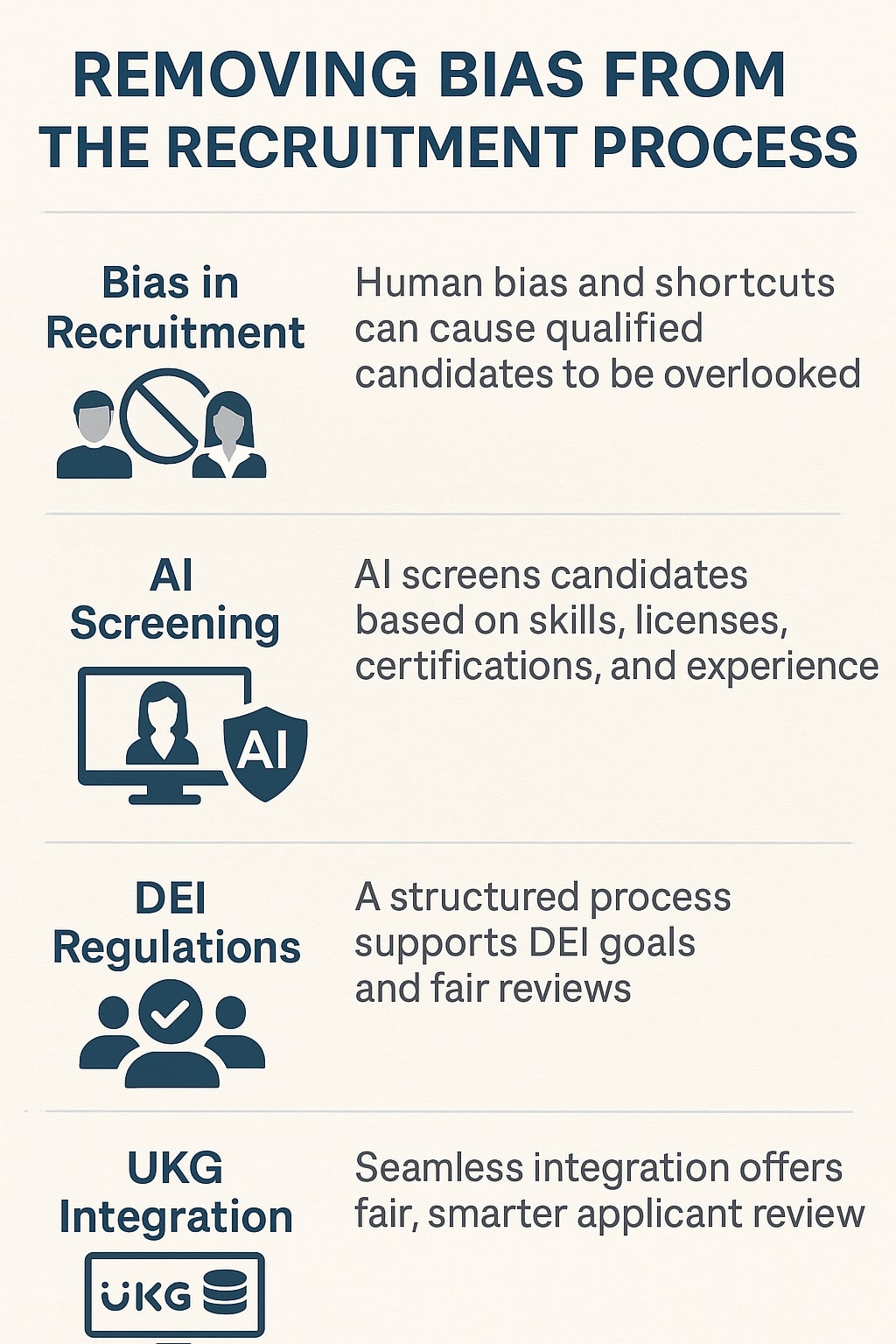
In early-stage screening, bias frequently enters the process through inconsistency. When recruiters are reviewing large volumes of applications under time pressure, they rely on heuristics — patterns from past experience — that may not reflect the actual criteria most predictive of success in the role. Candidates from certain educational backgrounds, with certain name formats, or whose resumes follow certain structural conventions may receive more favourable initial assessments than equally or more qualified candidates whose resumes do not fit the familiar pattern. AI screening, applied consistently, can reduce this variability by assessing every candidate against the same defined criteria rather than against an intuitive standard that shifts across reviewers and sessions.
The important qualification is that AI does not eliminate bias — it transforms it. If the criteria used to configure the screening model reflect historical patterns that disadvantaged certain groups, the model will reproduce those patterns consistently and at scale. This is why the configuration and ongoing auditing of AI screening tools is as important as the technology itself. Regular review of scoring outcomes across demographic groups, clear documentation of the criteria used in screening decisions, and maintained human oversight at key stages are all necessary components of responsible implementation.
Used with appropriate governance, AI recruiting for UKG can improve screening consistency and help ensure that early-stage decisions are based on job-relevant criteria rather than irrelevant proxies. It is a meaningful step toward more equitable hiring — not a complete solution, but a genuine improvement over unstructured, high-volume manual review.
CloudApper AI Recruiter for UKG Pro and UKG Ready: How It Works
CloudApper AI Recruiter is designed to work alongside the UKG applicant tracking system rather than replace it. UKG Pro or UKG Ready remains the system of record for all candidate and hiring data. CloudApper AI Recruiter connects through standard APIs and adds automation, conversational workflows, and screening intelligence at the workflow layer — improving speed, consistency, and candidate experience without requiring changes to the underlying UKG configuration.
Conversational Application Flows
Candidates can begin applying through a QR code, SMS shortcode, or chat interface, entering a guided conversational flow that collects structured application data without the friction of a long-form portal. This significantly reduces abandonment at the first step of the funnel and widens the candidate pipeline, particularly for mobile-first applicants who are most representative of frontline and hourly workforces.
Contextual Resume Screening and Candidate Scoring
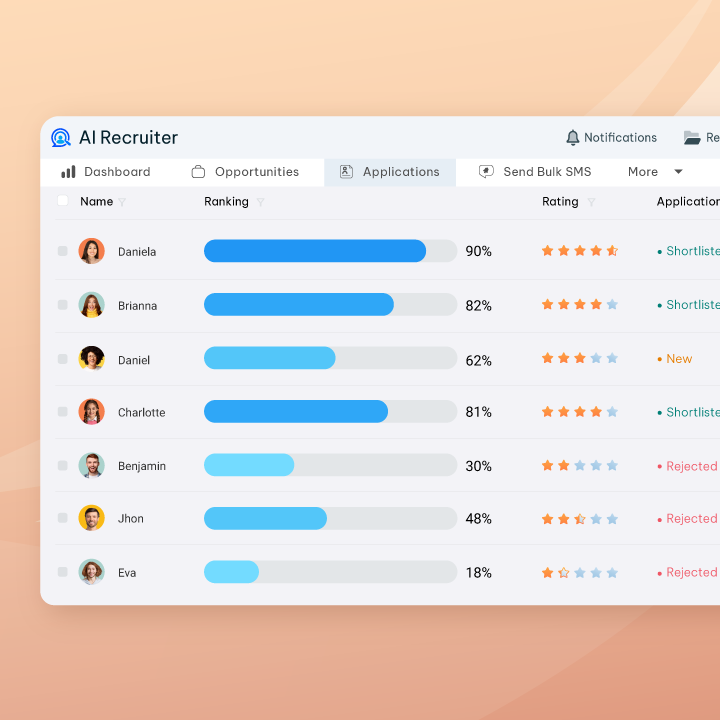
CloudApper AI Recruiter evaluates incoming applications against role-specific criteria configured for each requisition — experience, skills, availability, qualifications, and any additional factors relevant to the role. The output is a scored, ranked shortlist that recruiters can act on immediately. Every candidate is assessed against the same framework, ensuring consistency regardless of application volume or review timing.
Dynamic Pre-Screening
Pre-screening questions are delivered conversationally and can branch based on candidate responses, collecting the role-specific information — shift availability, certifications, location constraints, scenario-based responses — that standardised forms fail to gather effectively. The resulting candidate profiles are richer and more actionable than those produced by static pre-screening processes.
Automated Interview Scheduling
Once candidates advance to the interview stage, CloudApper AI Recruiter manages the full scheduling workflow: presenting available time slots, collecting candidate selections, sending calendar confirmations, dispatching reminders, and handling rescheduling requests. This eliminates the coordination overhead that consumes significant recruiter time and accelerates the movement from shortlist to interview.
Always-On Candidate Engagement
Automated communication through SMS, email, and chat maintains continuous candidate engagement from application submission through interview and beyond. Every workflow event triggers the appropriate communication without recruiter action, ensuring that no candidate goes unacknowledged and that momentum is maintained throughout the hiring process.
Full UKG Integration
All candidate data, scoring outputs, engagement events, and scheduling records sync directly with UKG Pro or UKG Ready. There is no manual data transfer, no reconciliation process, and no risk of the UKG applicant tracking system falling out of sync with the AI layer. For IT teams evaluating integration quality, CloudApper AI Recruiter connects through standard APIs and does not require bespoke development or ongoing technical maintenance.
Frequently Asked Questions
Does UKG have an applicant tracking system?
Yes. Both UKG Pro and UKG Ready include applicant tracking system functionality for managing job requisitions, candidate pipelines, interview workflows, offer letters, and onboarding. UKG Pro is the enterprise-tier platform (successor to UltiPro) and UKG Ready is the mid-market platform (successor to Kronos Workforce Ready). Both include talent acquisition capabilities that can be extended with AI recruiting tools for high-volume or frontline hiring environments.
What is the difference between UKG Pro and UKG Ready for recruiting?
UKG Pro is designed for larger, more complex enterprise organisations and offers more extensive configurability, deeper analytics, and broader integration capabilities. UKG Ready is designed for mid-market organisations and provides a more streamlined set of talent acquisition tools suited to businesses with less complex workforce structures. Both platforms support AI recruiting integrations like CloudApper AI Recruiter.
How does AI work with the UKG applicant tracking system?
AI recruiting tools integrate with UKG’s ATS through standard APIs, connecting to job requisition and candidate data and feeding processed outputs — scoring results, engagement events, scheduling updates — back into UKG as the system of record. The AI layer handles the automation-heavy steps of the recruiting workflow: conversational application flows, resume screening, candidate scoring, pre-screening, scheduling, and communication. UKG remains the authoritative platform throughout.
Is CloudApper AI Recruiter compatible with Kronos recruiting workflows?
Yes. CloudApper AI Recruiter integrates with UKG Pro and UKG Ready, which are the current successors to the Kronos and UltiPro platforms respectively. Organisations that originally implemented Kronos Workforce Ready and have migrated to or are running UKG Ready can use CloudApper AI Recruiter to extend their recruiting capabilities. The integration connects to the current UKG platform regardless of the legacy system history.
Why do candidates abandon applications in UKG recruiting workflows?
Application abandonment in UKG and other ATS environments is primarily caused by application length, process complexity, and slow or absent follow-up communication. SHRM research has found that 92% of candidates who click apply never complete the process. AI recruiting tools address this by enabling conversational, mobile-friendly application entry points that reduce friction at the first step, and by automating follow-up communication that keeps candidates engaged through subsequent stages.
What types of organisations benefit most from AI for UKG talent acquisition?
Organisations with high-volume frontline or hourly hiring needs benefit most — particularly in retail, healthcare, manufacturing, logistics, hospitality, and call centre environments. Seasonal hiring operations, distributed multi-site organisations, and any team dealing with high historical drop-off rates or scheduling bottlenecks will see the strongest and most immediate impact from AI recruiting automation layered onto UKG’s applicant tracking system.
Will AI replace recruiters in UKG environments?
No. AI recruiting tools are designed to automate the repetitive, administrative steps in the hiring process — application processing, screening, scheduling, and communication — so that recruiters can focus on the work that requires human judgment: assessing cultural fit, advising hiring managers, building candidate relationships, and making final decisions. Recruiters become more productive and more strategically focused, not redundant.
Conclusion
UKG Pro and UKG Ready give organisations a well-supported, capable foundation for talent acquisition and workforce management. For recruiting teams managing standard hiring volumes, the native UKG applicant tracking system provides everything needed to run an effective, structured process. The challenge emerges at scale — when application volumes spike, candidate expectations accelerate, and the manual steps embedded in standard ATS workflows exceed the capacity of the recruiting team.
AI for UKG recruiting solves that challenge without requiring organisations to abandon the platform they already rely on. By automating the friction-heavy steps at the front end of the hiring process — application entry, screening, pre-screening, scheduling, and communication — AI tools make the UKG talent acquisition workflow significantly more capable at the volumes and speeds that frontline and high-volume hiring demands. Recruiters spend less time on administration and more time on the decisions and relationships that determine whether a hire succeeds.
CloudApper AI Recruiter is built to deliver that outcome within UKG Pro and UKG Ready environments, connecting directly to the UKG applicant tracking system and extending its capabilities through conversational workflows, consistent screening, automated engagement, and real-time synchronisation. For HR leaders, talent acquisition directors, and IT teams looking to get more from their existing UKG investment, it represents one of the most practical and immediately impactful options available.
Ready to extend your UKG recruiting workflow with AI? Contact CloudApper today to see how AI Recruiter can reduce time-to-fill, improve shortlist quality, and keep candidates engaged from first click to first day.
Key Takeaways
- UKG Pro and UKG Ready both include applicant tracking system capabilities — AI recruiting tools extend these capabilities for high-volume and frontline hiring without replacing UKG as the system of record.
- SHRM research found that 92% of candidates who click apply never complete the process — AI recruiting tools reduce abandonment through conversational, mobile-friendly application flows and automated follow-up communication.
- UKG Ready is the successor to Kronos Workforce Ready, and UKG Pro is the successor to UltiPro — AI recruiting integrations work with both platforms regardless of legacy system history.
- CloudApper AI Recruiter adds contextual resume screening, candidate scoring, dynamic pre-screening, automated scheduling, and always-on candidate engagement to UKG talent acquisition workflows.
- High-volume hiring in retail, healthcare, logistics, manufacturing, hospitality, and call centre environments sees the fastest ROI from AI recruiting automation — where displaced manual effort is greatest and candidate drop-off risk is highest.
- All candidate data and workflow events sync directly with UKG Pro or UKG Ready through standard APIs — no manual data transfer, no reconciliation overhead, and no disruption to existing UKG configuration.


October 26, 2026
Candidate Disposition Automation in UKG Pro Recruiting: The Decision Layer Between the Requisition and the Hire
At a growing healthcare network, UKG Pro Recruiting handles posting and onboarding well, but screening, status changes and manager review pile up in the middle. This piece looks at 14 manual dispositions, missing drop-off data and clinical hiring managers, and how CloudApper adds a decision layer on top of UKG Pro Recruiting.
October 8, 2026
Multi-Round Interviews in UKG Pro Recruiting: Automating Executive Panel Scheduling for Fund Administrators
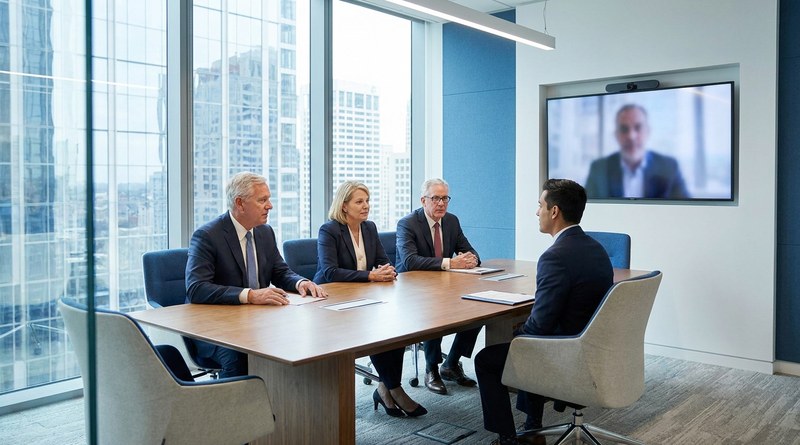
Senior hiring at a global fund administrator runs through many interview rounds and executive calendars across time zones. CloudApper AI Recruiter extends UKG Pro Recruiting to support every round, schedule executive panels through Outlook and Teams, and give recruiting leadership real-time KPIs on where each search stands.

September 15, 2026
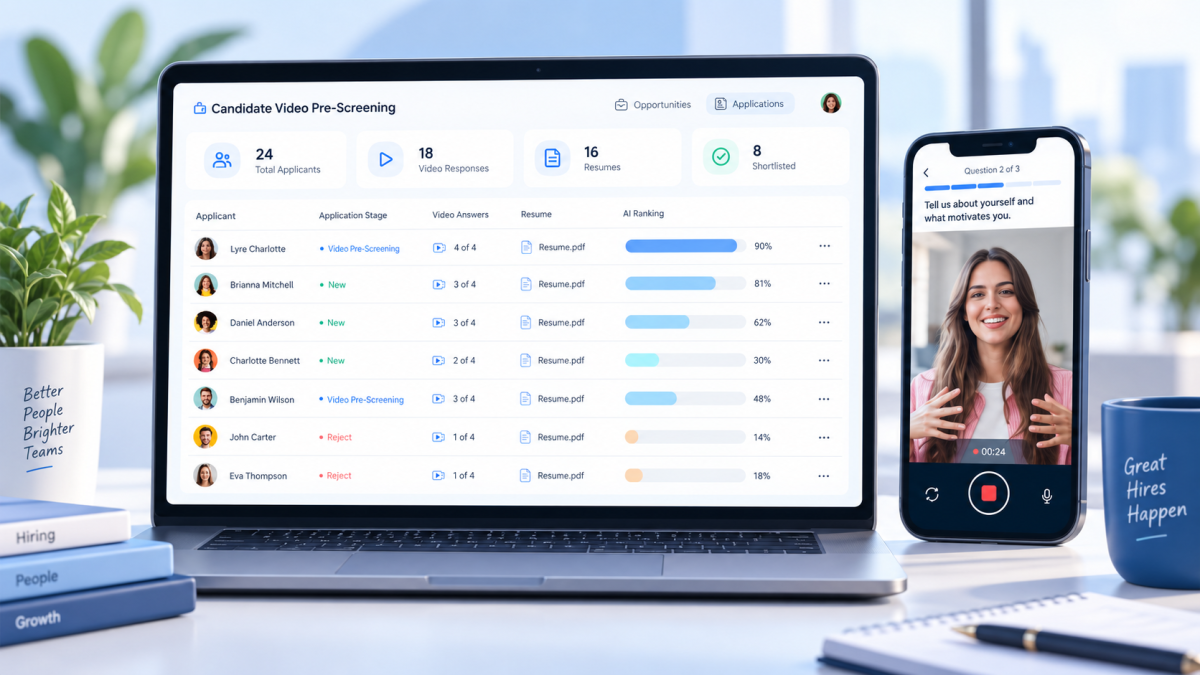
One-Way Video Interviews in UKG: Know Who’s Worth Interviewing Before the Interview
UKG video interviews let shortlisted candidates record answers on their phone, on their own time, so recruiters hear from a real person before booking any interview. The step runs alongside UKG Pro Recruiting or UKG Ready, and the ratings, transcripts, and recordings write back to the applicant record.

September 9, 2026
License-Based Onboarding in UKG Ready: Assigning Broker Forms by Line of Authority
An insurance brokerage's obligations start the moment a broker's hire record is created. Here is why license and location should decide each new broker's onboarding forms in UKG Ready, and how CloudApper derives that path from license data instead of relying on a choice among twenty static checklists.