
Learn how to improve candidate engagement with UKG and AI by reducing application drop-off, responding faster, and creating a clearer hiring experience. This guide shares practical strategies using UKG and AI to keep candidates engaged from application to offer.




Table of Contents
If you are struggling to keep candidates engaged, you are not alone. In my recent encounters with many TA leaders, I’ve seen application drop-off rates often reach 92%. That means out of every 100 people who start an application, only eight complete it. That level of loss is no longer acceptable for today’s talent market.
The good news is that the foundation is already there. UKG Pro and UKG Ready offer strong recruiting tools. What they need is help moving faster and responding in real time. This is where AI tools like CloudApper AI Recruiter for UKG come in. In this guide, I will walk you through practical ways on how to improve candidate engagement using UKG and AI, based on what I have seen work across healthcare, manufacturing, and retail teams.
TL;DR
-
How to improve candidate engagement: Reduce application friction, respond faster, and keep candidates informed at every stage.
-
Why candidates drop off: Long applications, slow responses, unclear next steps, and manual scheduling delays.
-
How UKG helps: UKG provides structured recruiting workflows and mobile-friendly applications.
-
How AI improves engagement: AI enables conversational applications, instant responses, faster screening, and self-service scheduling.
-
What to measure: Track application completion rate, time-to-response, interview acceptance rate, and time-to-hire.
Why Improving Candidate Engagement Matters More Than Ever
Candidate engagement is no longer just about being polite or responsive. It directly affects your ability to hire at all. When candidates lose interest early or stop responding, the entire hiring process slows down. Teams spend more time chasing updates, roles stay open longer, and qualified candidates quietly disappear. Understanding why engagement matters is the first step toward fixing it.
- The size of your qualified talent pool depends on engagement: When candidates lose interest early, most exit before recruiters can evaluate skills or fit. Fewer completed applications mean fewer strong options to choose from.
- Hiring speed slows down when engagement drops: Candidates who feel disconnected respond later, skip interviews, or disappear entirely. These delays extend time-to-hire and keep important roles open longer.
- Offer acceptance is shaped long before an offer is made: Candidates remember the pace, clarity, and respect shown during the process. Poor engagement creates hesitation and pushes talent toward faster-moving employers.
- Employer perception is formed during the application experience: For candidates, recruiting is their first real interaction with your organization. Silence and uncertainty signal internal friction and reduce confidence in leadership.
- Recruiter productivity suffers when engagement breaks down: Low engagement forces teams to re-source roles, restart pipelines, and repeat work. Consistent engagement preserves momentum and improves hiring outcomes at scale.
5 Proven Strategies to Improve Candidate Engagement with UKG & AI
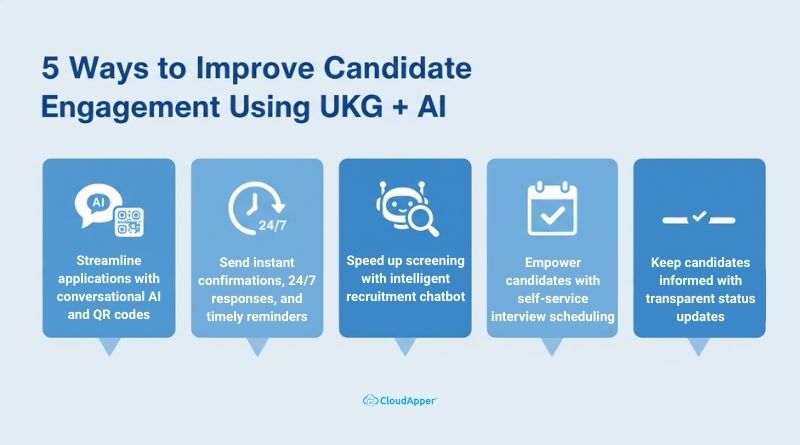
1. Simplify Applications with Conversational AI
One of the biggest reasons candidates drop off is long application forms. I still see job postings that ask candidates to fill out 20 or more fields on a small screen. Even motivated candidates abandon these forms halfway through.
UKG already helps by offering mobile-friendly job postings and resume imports from LinkedIn. That is a strong start. But in practice, it is still not enough for frontline and hourly roles where speed matters most.
CloudApper AI Recruiter extends UKG Pro and Ready by simplifying the job application process through its QR Code and Text-to-Apply functionality. Candidates can apply for jobs by simply scanning a QR code or sending an SMS. I have seen this approach double application completion rates almost overnight, especially in retail and healthcare hiring, where candidates apply on the go.
2. Maintain 24/7 Communication Through Intelligent Automation
Another common issue I see is silence. Candidates apply and hear nothing back for days. During that time, they assumed they were rejected or forgotten. Many simply stop checking.
CloudApper AI Recruiter helps close those gaps with fast, always-on automation. Automated acknowledgments go out within minutes, not days. Simple questions get answered instantly through the chatbot. Interview reminders arrive 24 hours before scheduled calls. This significantly helps you to keep candidates engaged during the recruitment process.
3. Accelerate Screening Without Sacrificing Quality
Few things hurt engagement more than waiting weeks for screening results. Candidates assume the role is no longer active and move on. Recruiters feel pressure, but manual resume review simply does not scale.
CloudApper AI Recruiter accelerates this step by guiding candidates through a conversational chatbot that prompts them to submit their resumes directly within the chat. It then instantly screens those resumes and asks targeted pre-screening and knockout questions based on the skills and experience mentioned in the resumes to immediately qualify or disqualify candidates.
If candidates wait too long for screening results, they usually move on before you ever speak with them.
4. Empower Candidates with Self-Service Scheduling
Scheduling interviews through email back and forth is one of the most frustrating parts of recruiting. Candidates wait days for available times. Recruiters chase responses. Some candidates drop off entirely during this stage.
CloudApper AI Recruiter improves this by sending self-service scheduling links to top candidates automatically. These links reflect real-time availability from your team’s calendars. Candidates choose a time that works for them without sending a single email. When scheduling is instant, engagement improves.
5. Create Transparency with Real-Time Updates
Many candidates describe applying for jobs as sending applications into a black hole. They submit information and never hear back. This lack of transparency damages your employer brand.
CloudApper AI Recruiter solves this by automatically pushing clear, stage-specific updates directly to candidates. As they move forward, they receive emails/SMS that say “Application received,” “Under review,” and “Interview scheduled.” This level of clarity builds trust. Candidates feel informed and involved instead of ignored.
Measuring Candidate Engagement Success in UKG
Measuring some key recruitment metrics can help you improve candidate engagement by pinpointing where the issue is. UKG provides a strong starting point, and AI-generated insights help you go deeper.
Key metrics I recommend tracking include application completion rate, time-to-response, interview acceptance rate, candidate satisfaction scores, and overall time-to-hire. In most organizations, the goal should be to raise completion rates above 60% and respond to candidates within 24 hours.
- Application Completion Rate: Percentage of candidates who start and finish submitting their application. Low rates usually indicate friction—lengthy forms, poor mobile experience, or confusing steps. Target >60% to capture more qualified applicants before they abandon the process.
- Time-to-Response: Average time from application/chatbot submission to the candidate’s first reply or acknowledgment. Responding within 24 hours greatly boosts engagement and reduces drop-off. Fast replies are strongly linked to higher interview attendance and better candidate perception.
- Interview Acceptance Rate: Percentage of screened candidates who accept an interview invitation. Low rates often point to weak employer branding, unattractive scheduling, or poor earlier experience. Tracking this reveals where interest fades in the funnel.
- Candidate Satisfaction Scores: Post-interaction feedback (e.g., 1–5 rating or NPS) collected after key touchpoints. Consistently low scores (<4/5 or NPS under +30) correlate with higher drop-off and negative reviews. This metric directly gauges how candidates view your hiring process and brand.
- Overall Time-to-Hire: Average days from application submission to accepted offer (or rejection). Faster cycles help secure top talent in competitive markets, but must be balanced with hire quality. Reducing this metric typically improves offer acceptance without sacrificing fit.
Use the recruitment dashboard in CloudApper AI Recruiter to identify where candidates drop off. If you see a sharp decline after application submission, your initial response is likely too slow. If candidates skip interviews, scheduling friction may be the issue. These are patterns I have tracked across many implementations, and they point clearly to where engagement needs improvement.
Conclusion: Building Engagement with UKG and AI
Improving candidate engagement with UKG is not about adding more steps or tools. It is about making the process faster, clearer, and more respectful of candidates’ time. UKG provides the structure. AI provides the speed and responsiveness that modern hiring demands.
If you are unsure where to start, pick one area. Conversational applications and automated scheduling often deliver the fastest results. As you build confidence, you can expand into screening and real-time communication.
Candidate engagement breaks down in different places for different teams. Identifying where it happens in your process makes all the difference..
Frequently Asked Questions
-
Why is candidate engagement important in hiring?
Candidate engagement directly impacts application completion, hiring speed, and offer acceptance. Poor engagement leads to higher drop-off and longer time-to-hire. -
How does UKG support candidate engagement?
UKG provides structured recruiting workflows, mobile-friendly applications, and core communication tools that form the foundation for engaging candidates. -
How can AI improve candidate engagement in UKG?
AI improves candidate engagement by enabling faster responses, conversational applications, automated screening, self-service scheduling, and real-time status updates. -
What causes candidates to drop off during the hiring process?
Common causes include long application forms, slow responses, unclear next steps, scheduling delays, and lack of communication after applying. -
Which candidate engagement metrics should recruiters track?
Recruiters should track application completion rate, time-to-response, interview acceptance rate, candidate satisfaction scores, and overall time-to-hire.