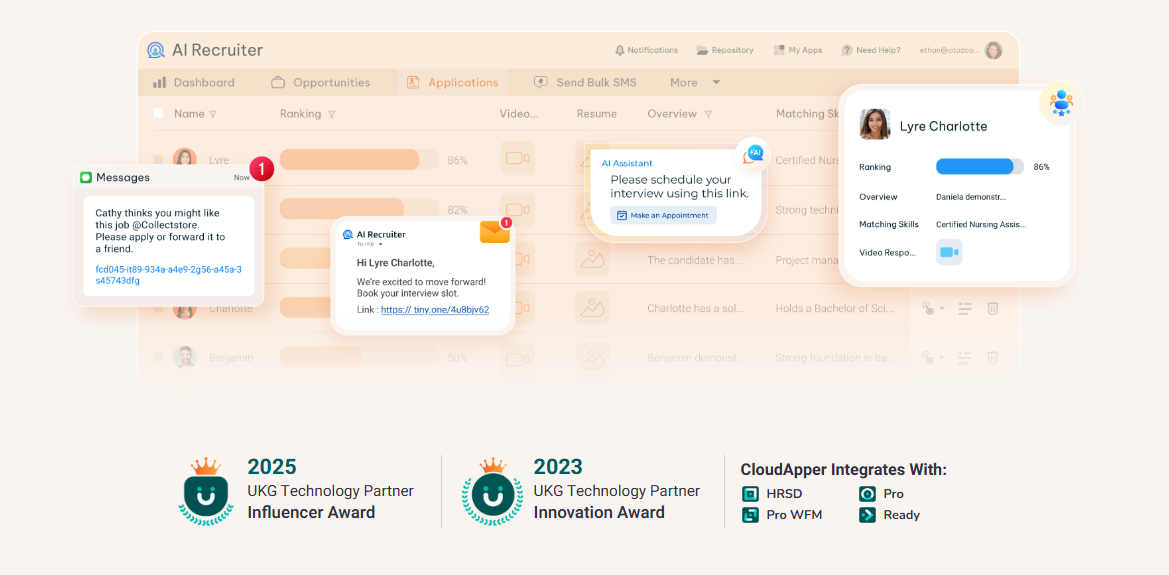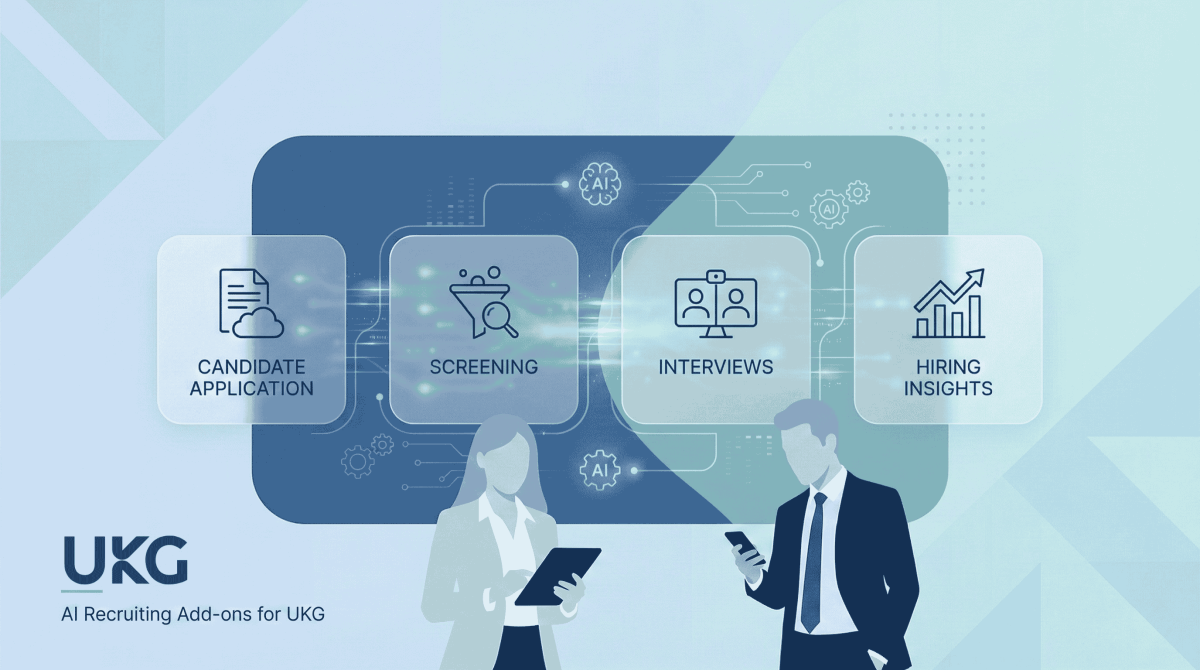

Struggling to fill critical healthcare roles? Discover how AI-powered screening with CloudApper AI and UKG Pro Recruiting accelerates hiring of nurses, LPNs, and allied health professionals. Automate license verification, rank candidates by specialty fit, and schedule interviews instantly—cutting hiring delays while maintaining full compliance and data accuracy.



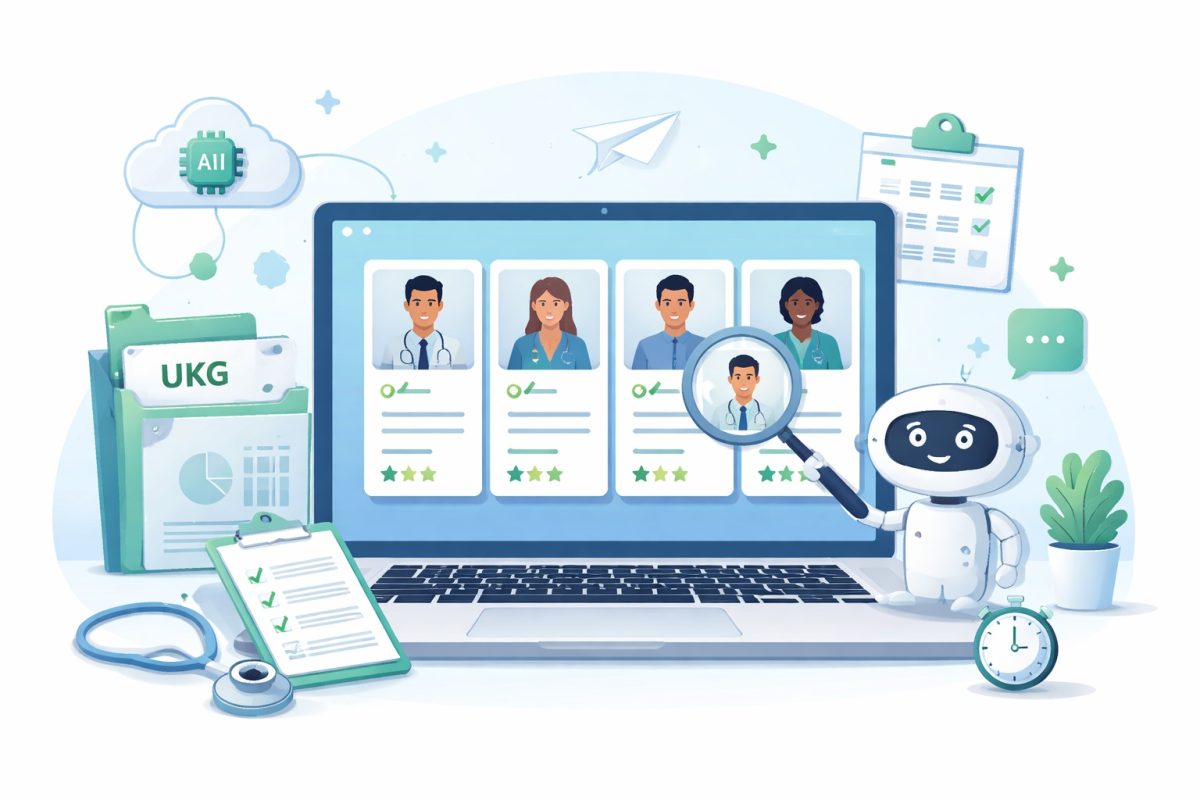
Table of Contents
Recruiting healthcare staff has never been easy — but lately it feels like the game changed overnight. You’re competing for the same nurses, technicians, and allied health professionals as every other health system in your region, you need to verify credentials before anyone sets foot on a floor, and your hiring manager was hoping to have someone credentialed and scheduled by next week.
The good news: AI-powered candidate screening, layered on top of UKG Pro Recruiting, can cut the time it takes to move from job post to offer — without cutting corners on the compliance and credential checks that healthcare hiring demands. This guide walks you through exactly how it works, from the first application to the first shift.
| The numbers | What they mean for healthcare HR |
| 40–50% | Average reduction in time-to-fill when AI handles initial screening (SHRM, 2023) |
| 3 in 4 | Healthcare organizations report credential verification as their biggest screening bottleneck |
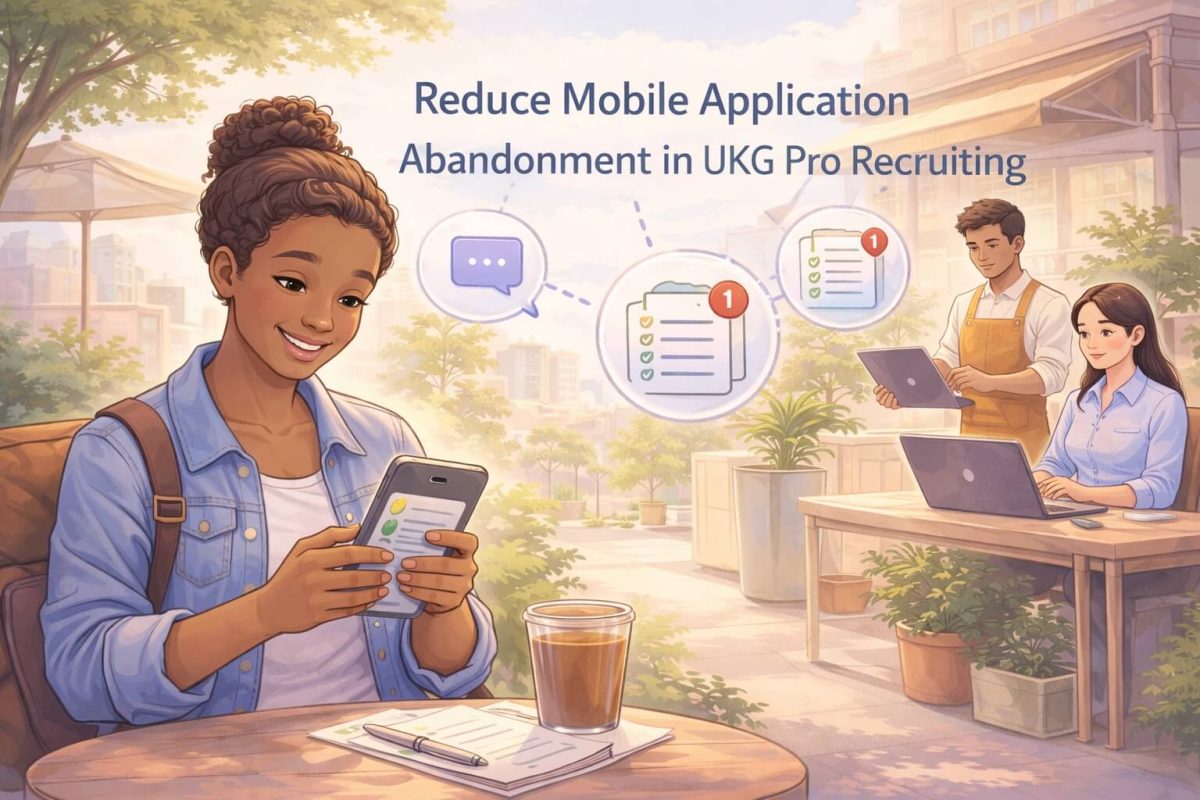
| 68% | Of nursing candidates drop off mid-application when the process takes more than 20 minutes |
| 2× | More qualified candidates reach the interview stage when AI pre-screening filters for license status first |
TL;DR
CloudApper AI integrates with UKG Pro Recruiting to help healthcare organizations hire nurses, technicians, and allied health staff faster. It automates structured applications, real-time license and credential verification, role-fit ranking, and personalized outreach—reducing time-to-fill by up to 40-50% while ensuring compliance.
Why Healthcare Recruiting Is a Different Problem
Most HR software treats a job application the same way regardless of role. Healthcare recruiting cannot afford that. A candidate who looks great on paper is still unplaceable if their RN license lapsed six months ago, if they haven’t completed required annual training, or if their credentials don’t match the specific unit they’d be working in.
This creates a screening problem that compounds quickly. Your team is reviewing applications manually, chasing documents, and waiting on state licensing boards — all before a single interview happens. Meanwhile, good candidates are accepting offers elsewhere.
AI-assisted screening inside UKG Pro Recruiting addresses this at the front end of the funnel, where the bottleneck actually lives.
| 💡 Quick note on terminology
Throughout this article, ‘AI screening’ refers to automated rules-based filtering combined with machine learning ranking — not autonomous hiring decisions. Humans review candidates; AI surfaces the right ones faster. |
How AI Pre-Screening Works Inside UKG Pro Recruiting
UKG Pro Recruiting integrates with AI screening tools to automate the early stages of candidate evaluation. Here’s what that looks like in practice:
Step 1 — Structured application intake
When a candidate applies, the system collects structured data: license numbers, certification types, years of experience by specialty, shift availability, and preferred unit. Unlike unstructured resume uploads, structured intake means the AI has clean, comparable data to work with immediately.
Step 2 — License and credential verification
The AI layer checks license numbers against state nursing board databases and other primary sources in real time. Candidates with expired, inactive, or flagged licenses are flagged before a recruiter sees the application — not after the phone screen. This alone eliminates one of the most time-consuming manual steps in healthcare recruiting.
Step 3 — Role-fit ranking
Once credentials clear, the AI ranks candidates based on how closely their experience matches the specific role. A candidate with five years in a cardiac ICU ranks differently for a telemetry position than a med-surg position, even if both roles are listed as “RN.” Recruiters see a prioritized queue rather than an undifferentiated stack.
Step 4 — Automated outreach and scheduling
Top-ranked candidates receive automated outreach — a message that feels personal because it references their specific credentials and experience — with a link to schedule a screening call. UKG Pro Recruiting’s scheduling tools eliminate the back-and-forth that typically adds days to the process.
| 💡 What recruiters tell us
“Before AI screening, I was spending the first two hours of every morning just sorting out who had a valid license. Now I open UKG and my queue is already filtered. I spend that time on actual conversations.” |
Credential Verification: Getting It Right Without Slowing Down
This is the part of healthcare recruiting where speed and compliance feel like they’re in direct conflict. Moving fast risks missing a lapsed credential. Moving carefully means candidates accept other offers while you’re still waiting on paperwork.
AI screening resolves this tension by making verification a parallel process rather than a sequential one. Instead of:
Application received → Manual review → Credential check → Interview scheduling
The flow becomes:
Application received → [AI credential check + role-fit ranking simultaneously] → Recruiter reviews pre-verified shortlist
What the AI can handle automatically:
- RN, LPN, and allied health license status verification against state boards
- BLS, ACLS, PALS, and specialty certification expiration checks
- DEA registration status for applicable roles
- Flagging candidates whose documents are missing or incomplete
What still requires a human:
- Judgment calls on candidates with recent license reinstatements
- Clinical reference checks and peer feedback
- Interviews for leadership, culture fit, and unit-specific scenarios
Screening for Specific Healthcare Roles
Not all healthcare positions have the same screening requirements. Here’s how to configure your UKG Pro Recruiting workflow for common role types:
Registered Nurses (RN) and Licensed Practical Nurses (LPN)
- License type and state of issuance as a hard filter — no license, no queue entry
- Specialty certifications (CCRN, CEN, ONC) weighted in ranking but not required unless role-specific
- Shift flexibility and full-time vs. per-diem preference collected at application to route to correct requisition
Allied Health (Radiology, Lab, Respiratory, PT/OT)
- ARRT, ASCP, NBRC, and similar board certifications verified at intake
- Equipment-specific experience (CT vs. MRI, specific analyzers) captured via structured questions
- State licensure requirements vary significantly — configure state-specific rules in UKG if hiring across multiple locations
Per Diem and Travel Staff
- Credential verification is even more critical for agency and travel placements — the AI check adds a layer of protection
- Availability windows and preferred units collected at application so scheduling can begin immediately after offer acceptance
- Consider a faster screening SLA for per diem roles — AI screening makes a 24-hour turnaround realistic
Setting Up Your Workflow in UKG Pro Recruiting
If you’re configuring this for the first time, here’s the practical sequence:
- Define your screening criteria by role family. Work with your clinical leads to agree on which credentials are hard requirements vs. preferred. Build these into your requisition templates in UKG.
- Configure the AI screening integration. Connect your credential verification provider (Nursys, VeriCre, or similar) to UKG Pro through the available API integrations or your UKG implementation partner.
- Build your application form. Replace free-text resume uploads with structured fields wherever possible. The more structured the input, the more reliable the AI output.
- Set your recruiter queue preferences. Decide whether recruiters see all applicants (with AI ranking) or only those who pass a credential threshold. Most healthcare teams prefer the latter.
- Configure automated outreach. Set up the first-touch message and scheduling link in UKG’s communication tools. Review the template with your clinical hiring managers — tone matters in healthcare recruiting.
- Run a pilot on one role family. Start with a high-volume role (RN or CNA) where you have enough applicant data to evaluate the AI ranking quality before rolling out organization-wide.
Finding Remote Healthcare Talent
Telehealth, remote patient monitoring, and administrative clinical roles have expanded the pool of healthcare positions that can be filled with fully remote candidates. AI screening makes this easier because geography is no longer a filter — and the credential verification process works regardless of where the candidate is located.
A few things to get right when hiring remote healthcare staff:
- Verify state licensure for the state where the patient is located, not just where the candidate lives — telehealth compact states complicate this
- Add a structured question about home workspace and HIPAA compliance setup — it saves a conversation later
- Schedule video screening calls within 24 hours of application for remote roles; remote candidates are typically evaluating multiple opportunities simultaneously
- Use UKG Pro Recruiting’s offer management to issue and countersign offers digitally — delays at the offer stage are where remote candidates are most likely to drop
Common Questions
Does AI screening introduce bias into healthcare hiring?
It can, if configured carelessly. The most important safeguard is auditing your screening criteria regularly — if a criterion (like a specific school or certification program) correlates with demographic characteristics rather than actual job performance, remove it. UKG Pro Recruiting’s reporting tools let you track pass-through rates by demographic group, which is a useful early-warning signal.
What if a candidate’s license is pending renewal?
Build a “pending” category into your workflow rather than a hard decline. Candidates with licenses in active renewal can move to a conditional pipeline — interviewed and offered contingent on license confirmation — rather than being filtered out entirely. This is especially useful for new graduates waiting on board results.
How long does setup take?
Most healthcare organizations with an existing UKG Pro Recruiting instance can configure basic AI screening in two to four weeks. The longer part is usually aligning internally on which credentials are hard requirements vs. preferred — a conversation worth having before you start configuring anything.
Can we use this for agency and travel staffing as well as direct hires?
Yes — and the credential verification component is arguably more valuable for agency placements, where credentials may not have been verified as recently. Configure a separate requisition workflow for agency fill so the screening criteria match your float pool requirements rather than your permanent hire requirements.
Ready to build a faster healthcare recruiting workflow?
CloudApper AI works alongside UKG Pro Recruiting to automate candidate screening, credential verification, and interview scheduling — purpose-built for the complexity of healthcare hiring. Talk to our team about how other health systems have cut time-to-fill by 40% or more.